Petroleum Coke
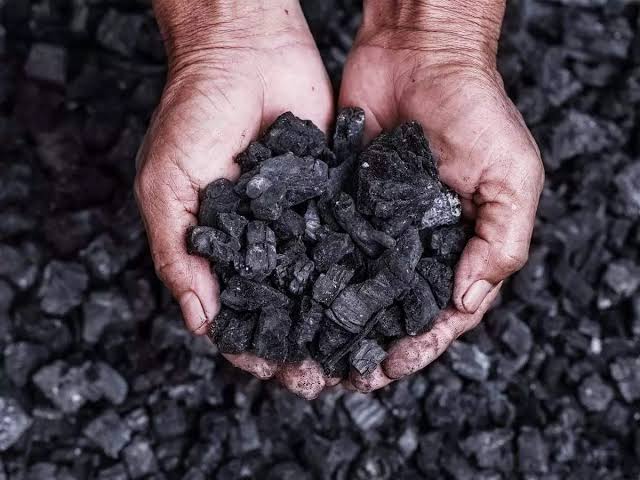
Petroleum coke, abbreviated coke or petcoke, is a final carbon-rich solid material that derives
from oil refining, and is one type of the group of fuels referred to as cokes. Petcoke is the coke
that, in particular, derives from a final cracking process—a thermo-based chemical engineering
process that splits long chain hydrocarbons of petroleum into shorter chains—that takes place
in units termed coker units. (Other types of coke are derived from coal.) Stated succinctly, coke
is the “carbonization product of high-boiling hydrocarbon fractions obtained in petroleum
processing (heavy residues)”. Petcoke is also produced in the production of synthetic crude oil
(syncrude) from bitumen extracted from Canada’s oil sands and from Venezuela’s Orinoco oil
sands.
In petroleum coker units, residual oils from other distillation processes used in petroleum
refining are treated at a high temperature and pressure leaving the petcoke after driving off
gases and volatiles, and separating off remaining light and heavy oils. These processes are
termed “coking processes”, and most typically employ chemical engineering plant operations
for the specific process of delayed coking.
This coke can either be fuel grade (high in sulfur and metals) or anode grade (low in sulfur and
metals). The raw coke directly out of the coker is often referred to as green coke. In this context,
“green” means unprocessed. The further processing of green coke by calcining in a rotary kiln
removes residual volatile hydrocarbons from the coke. The calcined petroleum coke can be
further processed in an anode baking oven to produce anode coke of the desired shape and
physical properties. The anodes are mainly used in the aluminium and steel industry
Petcoke is over 80% carbon and emits 5% to 10% more carbon dioxide (CO2) than coal on a
per-unit-of-energy basis when it is burned. As petcoke has a higher energy content, petcoke
emits between 30 and 80 percent more CO2 than coal per unit of weight. The difference between coal and coke in CO2 production per unit of energy produced depends upon the
moisture in the coal, which increases the CO2 per unit of energy – heat of combustion – and
on the volatile hydrocarbons in coal and coke, which decrease the CO2 per unit of energy